Thymosin α1 (Tα1) — The Immune System's Commander
An overview of thymosin α1, a thymic peptide used internationally as an immune-modulating adjunct in oncology, covering its mechanisms, clinical history, and community dosing practices.
Overview
Immunity is less a static shield than a living orchestra — its instruments tuned by molecular cues that can amplify or silence critical defences. Among the emerging conductors of that orchestra is thymosin α1 (Tα1), a 28-amino-acid peptide first isolated from thymic extracts and now recognised as a broad immunomodulator. By engaging Toll-like receptors 2 and 9 on dendritic and innate cells, Tα1 initiates MyD88–NF-κB signalling, triggers type I interferons, and accelerates the maturation of cytotoxic T lymphocytes and natural-killer cells. Preclinical data also point to direct pro-apoptotic actions in tumour lines and a capacity to dampen pathological cytokine release — positioning the peptide at the intersection of immune activation and immune resolution.
Clinically, Tα1 has accrued four decades of use outside the United States for hepatitis, vaccine adjuvancy, and — more recently — as an adjunct to checkpoint inhibitors and chemoradiotherapy.
What It Actually Does
Recruits more soldiers. Tα1 speeds up the training of new T cells and boosts the killing power of existing CD8⁺ T cells and natural-killer (NK) cells — the body's two main tumour hunters. (See the T Cells Overview for background on how these cells operate.)
Raises the alarm. It switches on immune "sensors" in frontline cells so they release messenger chemicals such as interferon-γ and interleukin-12 that rally the rest of the immune system.
Puts a bright flag on cancer cells. Tα1 increases display of "look-at-me" markers on tumour-cell surfaces, making them easier targets for T cells.
Keeps inflammation in check. While revving up infection-fighting signals, Tα1 also tones down excess inflammatory chemicals such as TNF-α that can damage healthy tissue.
May act on cancer cells directly. Laboratory studies show Tα1 can push some tumour cells toward self-destruction on its own.
Tα1 behaves like a "smart" immune modulator rather than a blunt stimulant — it mobilises defenders, improves their targeting, and helps limit collateral inflammatory damage, rather than simply pushing the whole immune system into overdrive.
Mechanisms of Action (Technical Summary)
TLR engagement and signalling — Tα1 binds TLR-2 and TLR-9 on dendritic cells and monocytes, activating the MyD88 → NF-κB pathway and inducing IL-12, IFN-α, IFN-γ, IL-2 and IL-10 production.
T-cell maturation and activation — accelerates thymocyte differentiation, expanding CD4⁺ and CD8⁺ pools and increasing cytotoxic T-lymphocyte activity.
Natural-killer and innate cell priming — boosts NK-cell cytotoxicity and augments dendritic-cell antigen presentation.
Enhanced antigen display — up-regulates MHC class I on infected or malignant cells, making targets more visible to cytotoxic lymphocytes.
Cytokine balancing — promotes Th1 cytokines while simultaneously suppressing excess IL-1β and TNF-α.
Direct antitumour signals — can trigger PTEN-mediated apoptosis and reduce migration through STAT3–MMP2 inhibition in tumour cells, an effect independent of immune activation.
Functional Outcomes Reported in the Literature
Better viral clearance (HBV, HCV, SARS-CoV-2) and improved vaccine responses through stronger adaptive immunity.
Adjunct cancer benefits including reversal of tumour-induced immune suppression and direct tumour-cell death.
Potential symptom control in chronic inflammatory or autoimmune states through cytokine re-balancing.
Comparing Tα1's Mechanisms with Other Agents
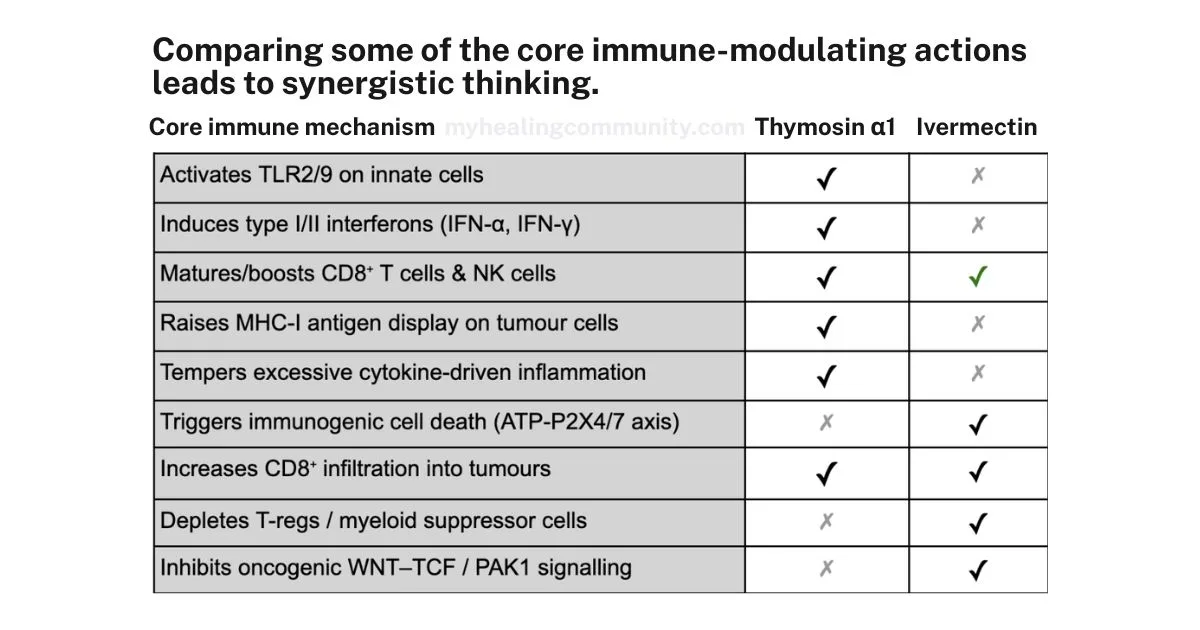
Comparing Tα1's mechanisms with those of other agents used for immune support leads to synergistic thinking. Tα1 and ivermectin, for example, act on largely non-overlapping arms of the cancer-immunity cycle — Tα1 strengthens innate sensing, interferon signalling, and antigen presentation, while ivermectin's reported effects involve immunogenic tumour-cell death, suppressive-cell depletion, and blocking pro-tumour signalling pathways. This complementary (rather than redundant) profile is the basis for exploring the two together, particularly in relation to CD8⁺ T-cell-mediated tumour clearance.
History and Global Regulatory Status
Thymosin α1 was purified from calf thymus in 1977 and entered cancer trials at the U.S. National Cancer Institute the following year. The synthetic form, thymalfasin, is identical in amino-acid sequence to the natural peptide. Early phase-I studies established a favourable safety profile and hinted at synergy with chemotherapy and interferon in patients with small-volume tumours.
Italy
The most sustained clinical development. Since the mid-1990s, Italian cooperative groups have tested Tα1 with dacarbazine, low-dose interferon-α, or interleukin-2 in stage IV melanoma, reporting objective response rates of 30–50% and median overall survival of around 13 months for responders. The peptide is licensed in Italy (brand name Zadaxin) as an orphan-drug adjuvant for melanoma and hepatocellular carcinoma (HCC).
China
Approved in the early 2000s for chronic hepatitis; oncologists subsequently adopted it off-label as a chemo- and radio-sensitiser. Retrospective cohorts suggest improved recurrence-free survival when Tα1 is added after curative hepatectomy for HBV-related small HCC, or combined with trans-arterial chemo-embolisation in unresectable disease. In non-small-cell lung cancer, meta-analyses of ten randomised trials (n≈700) show that adding Tα1 to platinum doublets raises overall response and NK-cell counts without added toxicity.
South-East Asia & Middle East
Regulatory approvals exist in Singapore, the Philippines, Indonesia, Turkey and the UAE, mainly for viral hepatitis, with local guidelines acknowledging adjunctive use in melanoma and HCC where other immunotherapies are unavailable.
European Union (outside Italy)
No marketing authorisation; the European Medicines Agency classifies Tα1 as an investigational biologic. Compassionate-use programmes in France and Spain have allowed access for metastatic melanoma and lung cancer, though uptake remains limited.
United States & Japan
Neither country licenses Tα1 for any indication. A December 2024 FDA review concluded the peptide "is not well-characterised" and found insufficient efficacy data for melanoma, HCC or NSCLC, despite a clean safety record across more than 5,000 patient-years of use elsewhere.
Current Oncology Use, by Indication
Regional clinical practice patterns reported in the literature include:
Melanoma (Italy, parts of Asia)
Used alongside dacarbazine, checkpoint inhibitors, or as maintenance after induction therapy.
Hepatocellular Carcinoma (China, Singapore)
Used post-resection or with TACE to curb recurrence.
NSCLC (China)
Used during platinum-based chemotherapy or concurrent chemoradiotherapy to preserve lymphocyte function.
Leukaemia
In vitro evidence shows Tα1 can damage leukaemia cells and enhance immune attack, but in vivo animal models have not shown reliable anti-leukaemia effects; overall the effects are small and inconsistent. Clinically, Tα1 is regarded here as a general immunomodulator rather than a leukaemia treatment in its own right.
The leukaemia evidence base is notably weaker than for melanoma, HCC or NSCLC — in vitro promise has not translated reliably into in vivo or clinical benefit.
Across regions, clinicians value Tα1 for its immunorestorative profile — boosting CD8⁺ T-cell and NK activity with minimal additive toxicity — making it a pragmatic adjunct where more expensive immunotherapies are inaccessible or poorly tolerated.
How It May Feel — A Patient View
Tα1 is often described by patients as a "smart" immune helper rather than a blunt stimulant. It appears to respond to where the immune system is struggling and nudges it back toward balance rather than simply pushing everything into overdrive.
When the immune system is tired or suppressed — for example after chemotherapy, chronic infection, or prolonged stress — Tα1 is reported to help "wake up" the T cells and NK cells responsible for cancer-cell hunting, virus clearing, and long-term immune surveillance. Many people using Tα1 for cancer support are aiming to restore this side of immunity so the body is better able to recognise tumour cells over time.
At the same time, Tα1 has a calming, organising effect on inflammation, helping frontline immune cells send clearer signals — enough to raise the alarm when needed, without tipping into a constant inflammatory flare. Some describe fewer infections, better vaccine responses, or more stable recovery between chemo or radiotherapy cycles; others describe slightly more energy or fewer post-exertion crashes.
Because Tα1 modulates rather than simply boosts, experiences vary. In deeply suppressed states, effects may feel like a gentle strengthening over weeks or months. In someone already running "hot" and inflamed, there can be a temporary phase of more active immune clean-up with more noticeable body sensations during adjustment — one reason careful dosing, non-consecutive injection days, and regular check-ins with a clinician matter.
In oncology settings, Tα1 is typically described as an add-on rather than a stand-alone treatment, combined with chemotherapy, radiotherapy or checkpoint inhibitors to protect immune cells, improve tumour visibility to the immune system, and support recovery between treatments. Outside active cancer, lower or less frequent use is sometimes discussed mainly in relation to recurrence-prevention and general immune resilience. In all cases, its effects are described as working best alongside the fundamentals that also shape immunity — sleep, blood-sugar balance, sustainable movement, stress regulation, and an anti-inflammatory way of eating.
Tα1 is a biologically active drug. People with organ transplants, those on high-dose steroids, or those with complex autoimmune conditions are described in the literature as needing specialist supervision. Any new fever, rash, breathing difficulty, or marked symptom change following a dose is flagged in clinical guidance as a reason to seek medical advice.
Dosing and Administration Patterns Described in Practice
The following reflects protocols and community sourcing information reported by members of the Healing Cancer Study Support Group and drawn from clinical literature; it is descriptive of how Tα1 has been used, not a personal recommendation.
Vial Strength and Reconstitution
A common starting point is a 5 mg vial of lyophilised powder reconstituted with bacteriostatic saline. Two reconstitution approaches have been described:
Larger injection volume: reconstituting with 3.0 mL of bacteriostatic water yields three doses of roughly 1.67 mg each when 1.0 mL (100 units) is drawn per dose.
More concentrated / smaller injection volume: reconstituting with 2.0 mL of bacteriostatic water yields a nominal concentration of 2.5 mg/mL, with 0.64 mL (64 units on a U-100 syringe) providing a 1.6 mg dose — three such doses from one vial, with a small remainder.
General handling notes from these protocols include cleaning vial tops and the work area, injecting bacteriostatic water gently against the glass wall of the vial and swirling rather than shaking, and refrigerating the reconstituted vial per standard peptide-storage guidance, discarding it if it becomes cloudy or shows signs of contamination.
Timing and Cycling
Non-consecutive dosing days (for example Monday/Thursday) are described as helping maintain TLR-driven signalling while avoiding tachyphylaxis, since inconsistent timing is reported to reduce the effectiveness of immune signalling. Continuous use is commonly limited to around six months in oncology settings, with reassessment of lymphocyte subsets and cytokines every four to six weeks.
Reported thresholds prompting a pause and medical consultation in the protocols reviewed include injection-site reactions lasting more than 48 hours, eosinophil counts above 1.5 ×10⁹/L, or unexplained fever. Some protocols describe switching to once-weekly dosing for maintenance if white-cell counts rise above the reference range while the person feels well.
Co-therapy
Tα1 is frequently paired in the literature with checkpoint inhibitors or low-dose IL-2, with no additive toxicity reported in trials.
Injection Site and Equipment
Described sites are areas with pinchable subcutaneous fat — abdomen, outer thigh, or back of the upper arm — administered subcutaneously (not intramuscularly), with site rotation for comfort. Thin needles (29–31 G) and lengths of 8–13 mm are described as suited to this route, with shorter needles or a 45° angle suggested for leaner individuals and longer needles for those with more subcutaneous fat.
Dose-Ranging Observations
Several studies describe a ceiling effect above 6.4 mg per injection, where higher doses do not further increase IL-2/IFN-γ but add cost.
Individuals under 50 kg or with renal impairment are sometimes described as starting at a lower dose to minimise local-site reactions before titrating.
Some sources suggest that when cancer is not active and the goal is recurrence prevention, a lower twice-weekly dose may be considered sufficient at lower cost.
Pharmacokinetically, subcutaneous bioavailability is reported as approximately 100% with a half-life of about 1.5 hours, while downstream gene activation is described as lasting 24–48 hours — cited as the rationale for twice-weekly dosing schedules.
For very low lymphocyte counts, some protocols describe a short "loading" course at a higher daily dose for 5–7 days before dropping to a twice-weekly maintenance dose, with continuous individualisation to weight, concomitant therapies, and immune-monitoring results discussed with a treating clinician.
Safety Snapshot
Most commonly reported adverse events are mild injection-site redness (in roughly ≤10% of cases), transient headache, and chills.
No significant myelosuppression has been reported; Tα1 is described as often mitigating chemotherapy-induced neutropenia (see Neutropenia — Low White Blood Cell Count for background on this side effect).
Use in organ-transplant recipients or those on high-dose steroids is described as requiring specialist oversight.
This information is for educational and informational purposes only. It is not intended as medical advice, diagnosis, or treatment. Please consult a healthcare provider before making any changes to a treatment plan or starting new supplements or peptides.
This overview draws on material curated by the Healing Cancer Study Support Group.