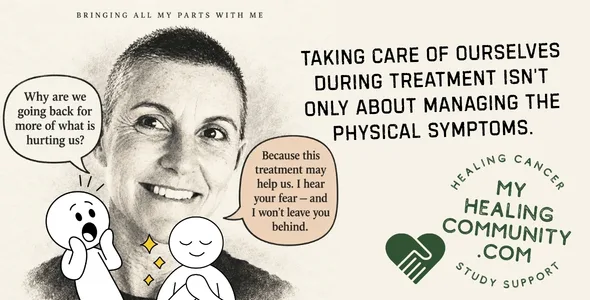
Taking care of ourselves during treatment isn't only about managing the physical symptoms.
A personal update on early physical side effects from the clinical trial, and how pausing to consider the parts of me that were not onboard helped so much.
The first three weeks on the RLY-2608 clinical trial
As many of you know, I'm now participating in a clinical trial of RLY-2608 alongside fulvestrant. I'll add a link to the post I wrote about the trial below for anyone who would like to read more about it.
I was genuinely excited to get onto this trial because of the way RLY-2608 has been designed: to selectively target the mutant forms of PI3Kα driving the cancer while largely sparing the normal, wild-type protein and other PI3K isoforms. That selectivity was a very important part of my decision.
Even so, over these first three weeks I've experienced more treatment-related side effects than I expected.
Mouth sores and a widening rash
Over the past few days, it began to feel as though the inflammation—already widespread across my skin and beginning inside my mouth—might move more deeply through my system. I prepared for the weekend by getting the steroid mouthwash, and my oncologist also prescribed oral steroidal anti-inflammatory medication to have available just in case.
Thankfully, the mouth inflammation settled with bicarbonate-and-water rinses and avoidance of acidic foods. The sores disappeared almost as quickly as they had arrived and didn't develop into anything worse.
My skin is still covered in a rash, although it has appeared in stages rather than all at once. It began across my torso, then appeared on my arms and around my groin and legs approximately four days later.
Because the rash on my torso had a four-day head start, I've been able to watch its course. The redness there has now gone, leaving only a little itchiness. I'm hoping the newer areas will follow the same pattern, with each section lasting about a week before settling. Hopefully, once that happens, I'll be through the worst of this first wave of side effects.
The harder days around day 12 to 24
For a while, it became pretty full-on: vomiting, terrible headaches, pain, restlessness and insomnia. I had colonic hydro therapy which helped heaps with the contraction and energy stagnation and toxicity that came across my body about 12.
The physical side effects were very real, but I came to recognise that a good deal of the suffering surrounding them—particularly during the initial pain and sleeplessness—had a psychological component for me.
Working with an IFS lens
I often use the Internal Family Systems—or IFS—approach to help me untangle inner and outer conflict. Looking through that lens, I realised that there were parts of me that simply weren't on board with what I was doing.
In my rush and excitement to access this highly targeted trial drug, I hadn't spent enough time with those parts of myself or helped them understand the full extent of the choice I was making.
That psychological dimension is always important for me: bringing understanding, empathy and compassion to the parts of us that can feel pushed around during treatment. None of us wants to put our body through something harsh, even when another part of us understands why we have chosen it.
By around day 12, the combination of fulvestrant and RLY-2608 seemed to send my body into a state of profound confusion. It felt as though my body were contracting, hiding and trying to run away. If it had been able to put that response into words, it might have said:
"This is insane. Continuing to go back for more of something that is causing so much disharmony isn't what you normally do."
And it was right. It isn't what I normally do.
So rather than arguing with those feelings or trying to force them out of the way, I began listening. I spent time befriending the parts of me that felt shocked, resentful, frightened or dismayed. I tried to help them understand why I had made this choice and reassure them that they had not been forgotten in the process.
Something shifted.
Where I am now
I'm now in a genuinely good place mentally and emotionally. Even through these last few days of rash and mouth sores, I've been surprised by how much difference that inner parts work has made.
The mindset work hasn't taken away the physical side effects, and I'm not suggesting that our thoughts cause or cure all of them. But changing my relationship with what was happening has reduced the additional layer of fear, resistance and inner conflict that had formed alongside and amplified them.
If I were still in that earlier state of confusion—with parts of me feeling unheard and dragged unwillingly through treatment—I think these physical side effects would have been much harder to bear.
For me, this has been another reminder that taking care of ourselves during treatment isn't only about managing the physical symptoms. Sometimes it also means pausing long enough to listen to the parts of us that are frightened by what we're asking our bodies to endure—and bringing those parts along with us, rather than leaving them behind.
If the IFS perspective I've described resonates with you, the IFS Institute is the best place to learn more. IFS has helped me meet frightened, resistant or overwhelmed parts of myself with curiosity and compassion rather than trying to silence or push past them—and for me, that has made a meaningful difference during treatment.
Related pages
The trial: ReDiscover-2 (NCT06982521)